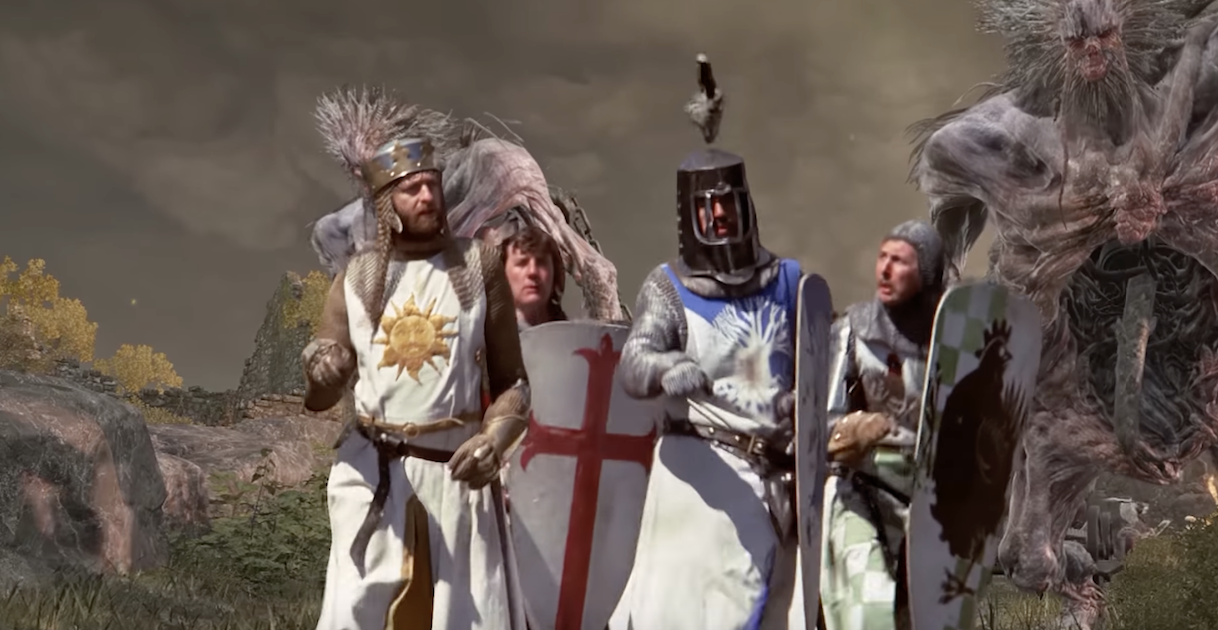
Kicking off Season 4 of the podcast, we review a Monty Python inspired film, integrating one of their greatest films with Elden Ring – Holy Grail. The film has been made by The Escapist in collaboration with eli_handle_b.wav and is a brilliantly edited and composited mashup. It is also a very appropriate pick for this episode since Monty Python were the inspiration for this podcast in the first place, so we reflect in the show that we’ve now been working on this podcast longer than the original Star Trek series ran + another 20 years collaborating on top of that too!
We also discuss news items: the launch of Starfield; Nexus Mods; Unity’s faux pas with the community of creators; Ricky’s attempt to install an AMD 7800T graphics card; and, the Sims Machinima & Animation Convention.
YouTube Version of This Episode
Show Notes and Links
Monty Python & the Elden Ring | Multiverse by The Escapist, released 8 August 2023
The Escapist is a website by gamers, for gamers, about gamers, releasing new videos every day at its website: http://www.escapistmagazine.com
A ‘how to’ using AI with largely free tools including Adobe Express to remove the background of images and put anything generated by AI back into the image, by Guy Parsons – https://twitter.com/GuyP/status/1704886297649631324
From AI to sci-fi to dystopian world stories, this week’s selection demonstrates creative tools and processes being used to realize these shorts.
Our first selection this week is a beautifully rendered morphing AI film called The High Seas, made using 60fps/4K by Drew Medina (released 9 Apr 2023) – one of the few we’ve seen so far. Embedding has been disabled, but please do follow the link here.
Constelar is by Oskar Alvardo (score by Lee Daish), released 4 Feb 2023. This has been made using Blender and an interesting approach to storytelling, with an almost 1970s noir feel to it –
The next film is a cinematic tribute to the makers of StarCraft, called Judgment Cinematic by Nakma, released 23 Mar 2023. The music (which we note is uncredited) adds much to the story telling but it also needs some understanding of the StarCraft world to fully appreciate the nuances in the plot which is vaguely Star Wars-ish. Nonetheless, a great effort, especially since it took just three months to make this machinima – there are some great shots and editing is well done –
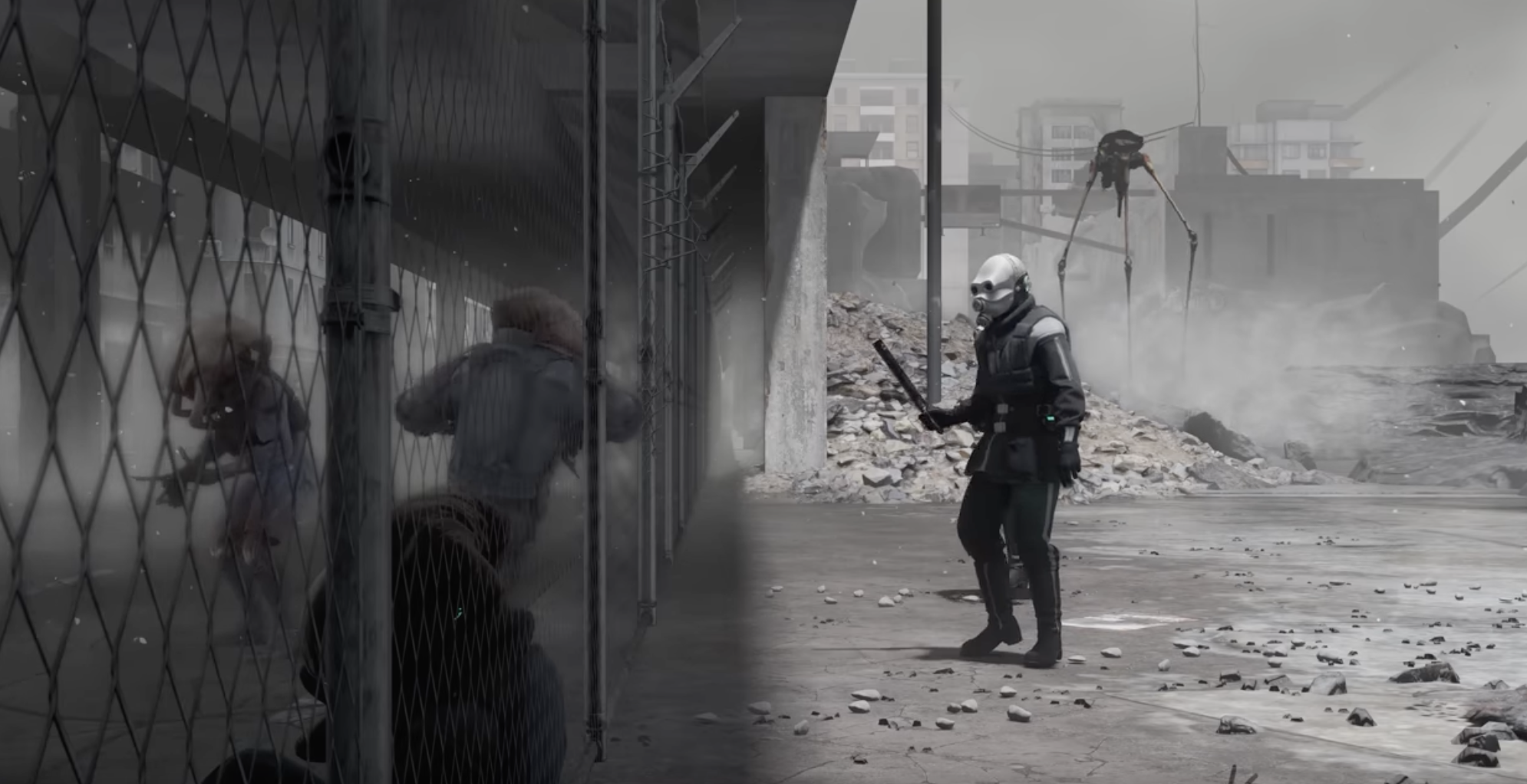
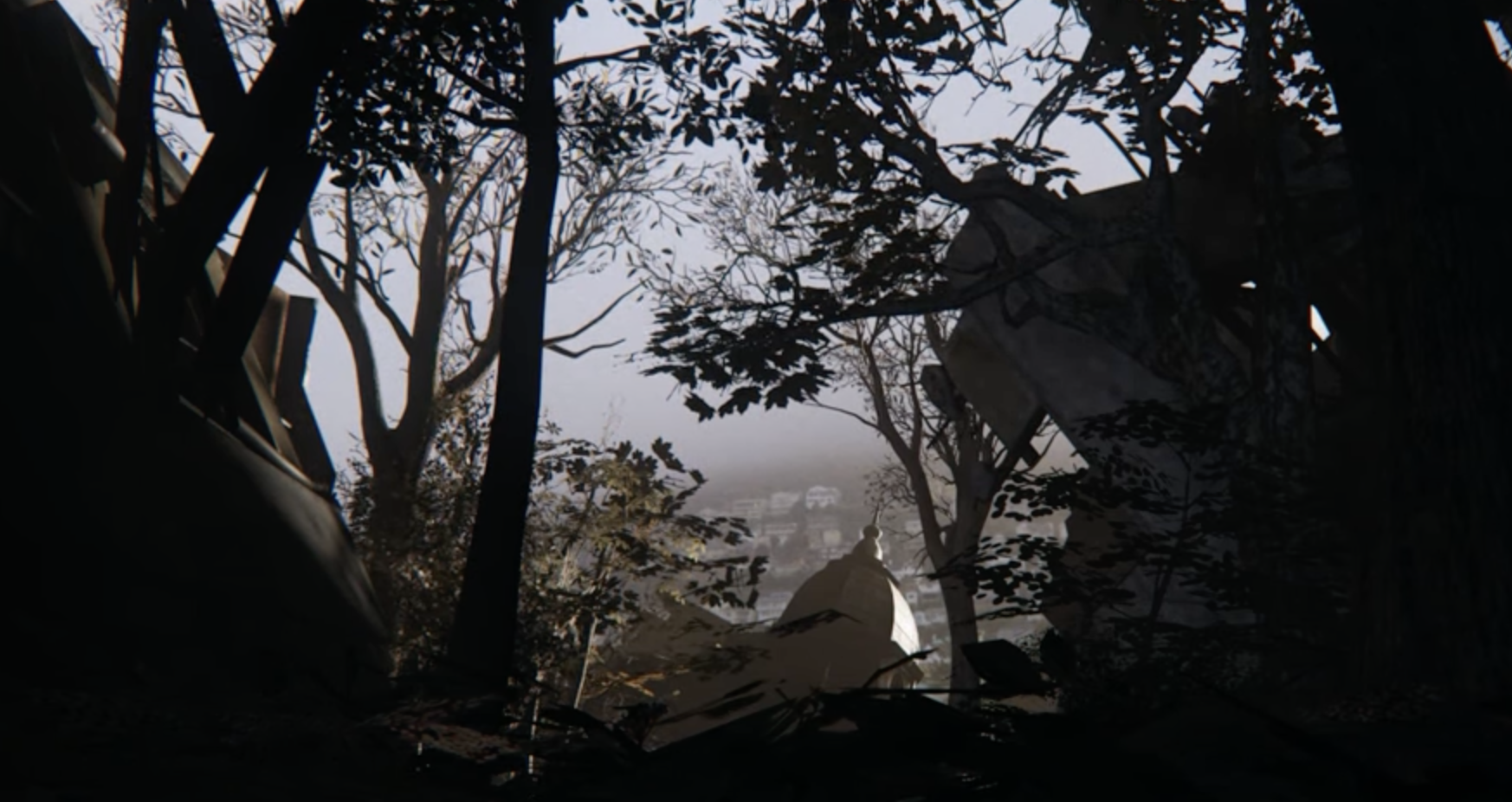
The dystopian world of Valve’s Half Life, made using Source Filmmaker, has been used in our next two film selections. The first is called Combined and draws on the lore in the game. It is quite violent but does well to ‘humanise’ the characters. The animation looks surprisingly old-style, even if it is only 2021 – a reflection on just how quickly the cinematic aesthetic has changed in such a short period of time. In Perimeter (our feature image for this post), which also portrays the Combine, there is quite a different aesthetic finish to it. What’s interesting about this film is the inspiration it drew from: concept art by Vyacheslav Gluhov. Both these films are great examples of how a game inspires creators to take one aspect, in this case the Combine character in HL, and extend the narrative into new and interesting directions.
This week, Ricky, Phil and Damien begin with an brief discussion of the roles AI is being used for to restore old machinimas, and in particular the very exciting upcoming release Phil will be doing of old Machiniplex films – more on that in due course!
The film discussion centres on After War by RG Studios and their approach to telling a story without moving a camera in the Half Life 2 world.
YouTube Version of this Episode
Show Notes & Links
Hitpaw video enhancer AI, subscription information here
Machiniplex, no longer exists as a platform/website, but the link on the archive is here for the moment!
This week’s film by RG Studios, released on 3 March 2023 –
The second of our March projects updates, this week we have a selection of work made using AI and live action.
Do The Evolution by Ricardo Villavicencio
We kick this week’s projects off with one of the first to be released by Runway Studios, whom we discussed in our Tech Update 1 on AI generators earlier this month. Released on 2 March 2023, this film is described as a posthumanist concept and whilst it starts with what seems like an homage to 2001: A Space Odyssey, it certainly ends with a slightly different narrative, vaguely reminiscent of Planet of the Apes. Its surreal for sure, and what’s interesting is that its been created with AI – although its not exactly clear whether that actually extends to the story’s plot too. Check it out here, and note it is the second of a trilogy from this creator although they are not all on the channel –
The film is also our featured image for this week’s blog post.
HALO – A Hero’s Journey by Raw Mind Pictures
We loved this! Its not actually a machinima production at all but a live action, shot in a quarry and supported by a community of cosplayers. The film was released 19 December 2021 and the channel includes a great ‘making of’ film too – lots of fun for Halo lovers everywhere –
Three days and 50 people, an impressive endeavour, and here’s the making of –
Nitro Warriors: A Stop Motion Animated Film by Vanguard Pictures
Not machinima and not even recent, but we just loved this awesome stop-mo which not surprisingly took 6 months to film, released 26 Aug 2012, such great timing to the soundscape –

A month is apparently a VERY long time in the world of artificial intelligence… since our last post on this topic, released at the beginning of December, we’ve seen even more amazing techs launch.
ChatGPT
This is another creative AI from the OpenAI stable (also creator of DALL-E 2) that produces text in a conversational way. ChatGPT is capable of answering pretty much any question or request you care to throw at it, and the answers are actually quite robust if a little fuzzy around the edges at times (don’t rely on it for anything critical, in the words of Sam Altman, OpenAI CEO). Here’s an example I asked it for this post, using the prompt: ‘In the style of H P Lovecraft, write a description of a character for someone who hunts the Chluthu’
Response:
Professor Alistair Dunsmore was a man obsessed. For years, he had devoted his life to studying the mysteries of the cosmos, and in particular, the myth of the Chluthu.
A brilliant but troubled man, Dunsmore was driven by a need to uncover the truth about the terrifying creature that lurked beyond the veil of our known universe. He had spent years pouring over ancient texts and forbidden tomes, piecing together the scattered clues that hinted at the Chluthu’s existence.
And then, one fateful day, he discovered something that would change his life forever. A fragment of an ancient artifact, imbued with otherworldly powers, that seemed to hold the key to finding the Chluthu.
Dunsmore knew that he had to have it, no matter the cost. And so he set out on a quest to track down the artifact and unlock its secrets. He traveled to the far corners of the earth, braving dangers and braving the unknown, all in the pursuit of his ultimate goal.
Some say that Dunsmore was mad, driven to the brink by his obsession. But to those who knew him, he was a hero, a brave and brilliant man who dared to stare into the darkness and face the horrors that lay within.
That’s impressive – and it took just seconds to generate. It has great potential to be a useful tool for scriptwriting for stories and character development that can be used in machinima and virtual productions, and also marketing assets you might use to promote your creative works too!
And as if that isn’t useful enough, some bright folks have already used it to write a game and even create a virtual world. Note the detail in the prompts being used – this one from Jon Radoff’s article (4 Dec 2022) for an adventure game concept: ‘I want you to act as if you are a classic text adventure game and we are playing. I don’t want you to ever break out of your character, and you must not refer to yourself in any way. If I want to give you instructions outside the context of the game, I will use curly brackets {like this} but otherwise you are to stick to being the text adventure program. In this game, the setting is a fantasy adventure world. Each room should have at least 3 sentence descriptions. Start by displaying the first room at the beginning of the game, and wait for my to give you my first command’.
The detail is obviously the key and no doubt we’ll all get better at writing prompts as we learn how the tools respond to our requests. It is interesting that some are also suggesting there may be a new role on the horizon… a ‘prompt engineer’ (check out this article in the UK’s Financial Times). Yup, that and a ‘script prompter’, or any other possible prompter-writer role you can think of… but can it tell jokes too?
Give it a go – we’d love to hear your thoughts on the ideas it generates. Of course, those of you with even more flAIre can then use the scripts to generate images, characters, videos, music and soundscapes. There’s no excuse for not giving these new tools for producing machine cinema a go, surely.
Link requires registration to use (it is currently free) and note the tool now also keeps all of your previous chats which enables you to build on themes as you go: ChatGPT
Image Generators
Building on ChatGPT, D-ID enables you to create photorealistic speaking avatars from text. You can even upload your own image to create a speaking avatar, which of course raises a few IP issues, as we’ve just seen from the LENSA debacle (see this article on FastCompany’s website), but JSFILMZ has highlighted some of the potentials of the tech for machinima and virtual production creators here –
An AI we’ve mentioned previously, Stable Diffusion version 2.1 released on 7 December 2022. This is an image generating AI, its creative tool is called Dream Studio (and the Pro version will create video). In this latest version of the algorithm, developers have improved the filter which removes adult content yet enables beautiful and realistic looking images of characters to be created (now with better defined anatomy and hands), as well as stunning architectural concepts, natural scenery, etc. in a wider range of aesthetic styles than previous versions. It also enables you to produce images with non standard aspect ratios such as panoramics. As with ChatGPT, a lot depends on the prompt written in generating a quality image. This image and prompt example is taken from the Stability.ai website –
source: Stability.ai
So, just to show you how useful this can be, I took some text from the ChatGPT narrative for our imaginary character, Professor Alistair Dunsmore, and used a prompt to generate images of what he might look like and where he might be doing his research. The feature images for this post are some of the images it generated – and I guess I shouldn’t have been so surprised that the character looks vaguely reminiscent of Lovecraft himself. The prompt also produced some other images (below) and all you need to do is select the image you like best. Again, these are impressive outputs from a couple of minutes of playing around with the prompt.
images of Professor Alistair Dunsmore, in his study, searching for the Chluthu, by Tracy & Stable Diffusion
For next month, we might even see if we can create a video for you, but in the meantime, here’s an explainer of a similar approach that Martin Nebelong has taken, using MidJourney instead to retell some classic stories –
Supporting the great potential for creative endeavour, ArtStation has taken a stance in favour of the use of AI in generating images with its portfolio website (which btw was bought by Epic Games in 2021). This is in spite of thousands of its users demanding that it remove AI generated work and prevent content being scraped. This request is predicated on the lack of transparency used by AI developers in training and generating datasets. Instead, ArtStation has removed those using the Ghostbuster-like logo on their portfolios (‘no to AI generated images’) from its homepage and issued a statement about how creatives using the platform can protect their work. The text of an email received on 16 December 2022 stated:
‘Our goal at ArtStation is to empower artists with tools to showcase their work. We have updated our Terms of Service to reflect new features added to ArtStation as it relates to the use of AI software in the creation of artwork posted on the platform.
First, we have introduced a “NoAI” tag. When you tag your projects using the “NoAI” tag, the project will automatically be assigned an HTML “NoAI” meta tag. This will mark the project so that AI systems know you explicitly disallow the use of the project and its contained content by AI systems.
We have also updated the Terms of Service to reflect that it is prohibited to collect, aggregate, mine, scrape, or otherwise use any content uploaded to ArtStation for the purposes of testing, inputting, or integrating such content with AI or other algorithmic methods where any content has been tagged, labeled, or otherwise marked “NoAI”.
You can also read an interesting article following the debate on The Verge’s website here, published 23 December 2022.
example of a logo used by creators on ArtStation portfolios
We’ve said it before, but AI is one of the tools that the digital arts community has commented on FOR YEARS. Its best use is as a means to support creatives to develop new pathways in their work. It does cut corners but it pushes people to think differently. I direct the UK’s Art AI Festival and the festival YouTube channel contains a number videos of live streamed discussions we’ve had with numerous international artists, such as Ernest Edmonds, a founder of the digital arts movement in the 1960s; Victoria and Albert Museum (London) digital arts curator Melanie Lenz; the first creative AI Lumen Prize winner, Cecilie Waagner Falkenstrom; and Eva Jäger, artist, researcher and assistant curator at Serpentine Galleries (London), among others. All discuss the role of AI in the development of their creative and curatorial practice, and AI is often described as a contemporary form of a paintbrush and canvas. As I’ve illustrated above with the H P Lovecraft character development process, its a means to generate some ideas through which it is possible to select and explore new directions that might otherwise take weeks to do. It is unfortunate that some have narrowed their view of its use rather than more actively engaged in discussion on how it might add to the creative processes employed by artists, but we also understand the concerns some have on the blatant exploitation of copyrighted material used without any real form of attribution. Surely AI can be part of the solution for that problem too although I have to admit so far I’ve seen very little effort being put into this part of the challenge – maybe you have?
In other developments, a new ‘globe’ plug-in for Unreal Engine has been developed by Blackshark. This is a fascinating world view, giving users access to synthetic 3D (#SYNTH3D) terrain data, including ground textures, buildings, infrastructure and vegetation of the entire Earth, based on satellite data. It contains some stunning sample sets and, according to Blackshark’s CEO Michael Putz, is the beginning of a new era of visualizing large scale models combined with georeferenced data. I’m sure we can all think of a few good stories that this one will be useful for too. Check out the video explainer here –
And Next…?
Who knows, but we’re looking forward to seeing how this fast action tech set evolves and we’ll be aiming to bring you more updates next month.
Don’t forget to drop us a line or add comments to continue the conversation with us on this.
Recent Comments