
iClone

S6 E241 Machinima News Omnibus (Sept 2026)
Tracy Harwood Podcast Episodes September 2, 2026 Leave a reply

In this news episode, Tracy Harwood and Damien Valentine explore three very different developments shaping machinima and virtual storytelling.

Tracy introduces DramaMancer, an experimental AI-powered storytelling platform developed through Midjourney’s Storytelling Lab. Rather than generating an entire story, DramaMancer combines an author’s characters, scenes and narrative framework with natural-language player input. Tracy considers whether this represents genuine player agency or merely a more sophisticated illusion of choice—and asks where authorship lies when stories are co-created by the writer, player and AI.

Damien responds by considering what happens when players push an AI-generated narrative so far from its intended path that the story can no longer progress, recalling the infamous research-order bug in X-COM: Terror from the Deep.

The discussion then turns to a recent panel featuring pioneers of Second Life machinima. Tracy reflects on how early creators transformed a social virtual world into a collectively maintained filmmaking environment through experimentation, shared knowledge and community initiatives such as Machinima Mondays. She contrasts this socially driven model of innovation with DramaMancer’s attempt to lower creative barriers through automation.

Finally, Damien discusses Reallusion’s new iClone RTX renderer, which promises ray-traced rendering inside iClone without exporting projects to NVIDIA Omniverse. He also explains his practical approach to facial performance capture with AccuFACE, including why subtle expressions, head movements and accurately performed dialogue can make such a dramatic difference to animated characters.

Audio Only Version of this Episode


YouTube Version of this Episode

https://youtu.be/YDBjXwlx2u0

Show Notes & Links

Dramamancer case study here, available on Storytelling Lab at Midjourney.

Q&A recorded at Silver City on 25 July 2026. The featured pioneers are Phaylen Fairchild, Chantal Harvey, Toxic Menges, Petlove Petshop and Saffia Widdershins –

Reallusion at SIGGRAPH 2026: with HP and NVIDIA RTX – Reallusion Magazine

RTX Render Open Beta Begins : Path-Traced Quality Inside Character Creator 5 and iClone 8
AccuFACE 2: AI Facial Mocap | iClone Motion LIVE

S6 E237 Machinima News Omnibus (Aug 2026)

Tracy Harwood Podcast Episodes August 5, 2026 Leave a reply

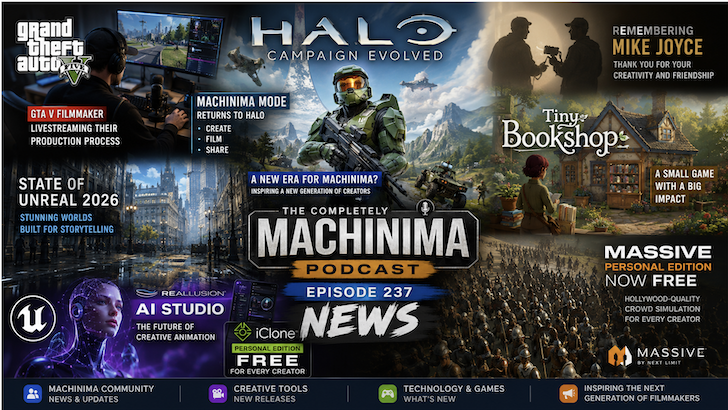
This week, the discussion centres on several significant developments across the machinima community, from community news and preservation of machinima history to new creative tools and the future of filmmaking platforms. The strongest recurring theme is how classic machinima practices are re-emerging through contemporary game engines and software, suggesting a renewed interest in machinima as a creative medium.

The episode opens with a tribute to Mike Joyce, longtime collaborator of Kate Fosk and member of the Moviestorm-era machinima community. The hosts reflect on his generosity, his contribution to Machinima Expo productions, and the supportive nature of earlier online machinima communities.

We discuss a PC Gamer feature covering a GTA V filmmaker who is livestreaming their production process.

Halo Campaign Evolved and the Return of “Machinima Mode” – we examine Microsoft’s remake of the original Halo, noting the inclusion of an officially branded Machinima Mode. The conversation broadens into a discussion of machinima history. Tracy observes that the remake is more than nostalgia—it is introducing machinima to third- and fourth-generation creators, demonstrating how enduring the medium has become.

Ricky argues that Red vs. Blue legitimised machinima as entertainment, while Damien explains how watching the series inspired his own filmmaking career. The discussion concludes with an invitation for creators to use Halo creatively rather than simply reproducing Red vs. Blue.

Tiny Bookshop – a lighter discussion follows around the success of Tiny Bookshop.

State of Unreal 2026 – Phil highlights a technical demonstration from Unreal Engine featuring highly detailed urban environments. The conversation highlights how production values in virtual filmmaking continue to approach traditional film set design. Video here –

Reallusion AI Studio and Free iClone Personal Edition – we discusses Reallusion’s biggest software announcement. Tracy suggests that Reallusion may be moving toward an Unreal-style ecosystem, where the software becomes a gateway to a scalable marketplace rather than the primary revenue source. We agree that making professional animation software freely available could significantly expand the machinima community. Launch video here –

Phil introduces the free personal version of Massive, the crowd simulation software used in The Lord of the Rings. The segment ends humorously with Ricky imagining an absurd “massive household” comedy requiring crowd simulation simply to go shopping. Demo and links here –

The major themes across the Episode are summarized as –

  • Remembering and celebrating machinima pioneers.
  • Evidence that machinima continues to influence commercial game development.
  • Lowering technical barriers for new creators.
  • Free creative software and accessible production pipelines.
  • Preservation of machinima history while encouraging new generations.
  • The continuing importance of storytelling over technology.

Audio Only Version of this Episode


YouTube Version of this Episode

https://youtu.be/FJtClXl3yfI

S6 E216 Machinima News Omnibus (Mar 2026)

Tracy Harwood Podcast Episodes March 5, 2026 Leave a reply

In this episode of Completely Machinima, Damien Valentine, Tracy Harwood, and Phil Rice unpack the biggest talking points at the intersection of machinima, AI, and creator rights.

We start with a quick birthday nod to id Software’s 35th anniversary—a foundational influence on game culture and the machinima scene—before diving into the headline debate: the Disney + OpenAI partnership. Tracy breaks down why Disney choosing licensing over litigation is a major signal for how entertainment giants may handle AI training and generation going forward—raising questions around copyright, compensation, and control. The team explores the ripple effects for fan creators: what stays “safe-ish,” what gets riskier when monetization enters the picture, and why platform policy enforcement (YouTube, TikTok, Steam Workshop) may tighten even before the law catches up.

From there, the conversation shifts to practical creator tech: new tools for posing and animation reference, the evolving state of video mocap (including clever ways to capture motion from existing footage), and the emerging frontier of text-to-motion generation. Finally, Phil highlights a standout release for creators: Hytale, a Minecraft-style sandbox game with built-in machinima tools (scriptable cameras, keyframe animation, and more) that could open up huge possibilities for in-engine filmmaking. Damien also points to Surviving Mars as another surprisingly useful source of cinematic footage thanks to its photo mode and camera controls.

The episode closes with two community spotlights: a playlist celebrating machinima creator Frank Fox, and a recommendation for the latest Biggs Trek chapter in the Forbidden Planet series.

Audio Only Version of this Episode


YouTube Version of this Episode

Show Notes & Links

The award-winning sci-fi city builder Surviving Mars: Relaunched

The $1bn deal will let fans generate videos and images of more than 200 Disney characters on ChatGPT and Sora. Creative industries ‘incredibly worried’ about OpenAI-Disney deal

Frank Fox Machinima –

BiggsTrek Ep 2! Forbidden Planet – Children Of The Krell (Chapter Two) –

HAELE 3D – Portrait Studio Pro is 3D facial anatomy drawing reference tool for beginner and advanced artists, with various characters, proportions, expressions lights and environments. HAELE 3D – Portrait Studio Pro – Drawing References

It is an easy to use app to complement tutorials, for those who are learning how to draw faces and heads.

Line of Action

Video Mocap any Games for iClone 8 Tested Work! #iclone #videomocap #gameplay #tutorial #3danimation –

Type It. Animate It. Swing Does It in Seconds –

Hytale is finally here!

Ultimate Hytale Machinima Tools Crash Course

How to Add Custom Humans to the Hytale Machinima Editor How to create Custom Animations for Hytale

S6 E211 Fantasy: Quest of the Key (Jan 2026)

Tracy Harwood Podcast Episodes January 29, 2026 Leave a reply

This week, we review a supporter-recommended iClone fantasy machinima that surprised us with its polish: “Quest of a Key – Chapter One” by AuroraTrek. We’re always saying we want more story-driven iClone machinima (and fewer tech-demo vibes)… and this one delivers on craft: strong shot selection, confident editing, excellent music cues, and character animation that’s smoother than you’d expect.

But then the conversation gets interesting.

We dig into sound mastering and spatial audio, the difference between “dry” dialogue and believable room tone, how stylized realism can drift into “clay-face” territory, and what happens when a series leans hard into character introductions without giving the audience enough plot hooks to chase. Tracy goes deep on the structure across multiple chapters, and we talk about why view counts can drop when episodes feel like long-form animation sliced into shorts.

We also get into pipeline talk: Daz characters into iClone, motion capture vs animation libraries, and the very real challenge of stepping from an established fan universe (Star Trek / Star Wars) into an original world where you don’t get story shorthand for free.

If you make machinima, virtual production, iClone films, or Unreal/CG shorts, this ep is packed with practical takeaways: pace, hooks, sound space, visual texture, and how to reveal character through action inside the plot.

Audio Only Version of this Episode


YouTube Version of this Episode

Show Notes & Links

Quest of the Key: a Fantasy Adventure Series – Chapter 1 – “Help Wanted” by Auroratrek, released 3 Feb 2023

S6 E207 Is that Bond… James Bond? (Jan 2026)

Tracy Harwood Podcast Episodes January 1, 2026 Leave a reply

🎬 This week on And Now for Something Completely Machinima, we’re shaking (and stirring) things up with a deep dive into Benjamin Tuttle’s long-awaited James Bond machinima, Endgame – Part One 🍸💥

Host Damien Valentine kicks things off by revealing he actually voices Q in the film (recorded years ago!), before the panel digs into why this project is such a standout. Created in iClone and rendered in Unreal Engine, Endgame delivers a Bond look and feel that’s grounded, stylish, and refreshingly not sci-fi flashy—London actually looks like London, and the tone leans classic rather than futuristic.

🎶 From its full-length Bond-style title sequence and original theme song to slick action choreography, witty humor, and loving nods to Bond lore (Spectre, Q, M, Cold War vibes, and yes—the car), we agree: this is a heartfelt homage made with serious craft. There’s also a touching dedication to Ken White, honoring the machinima community that helped shape projects like this.

Of course, no good Bond briefing is complete without critique 👀
We debate storytelling clarity, episodic structure, sound mixing, facial animation quirks, and whether Part One leaves us with enough of a cliffhanger to fully ignite anticipation for what comes next.

🎤 Along the way, we talk:

  • What makes a Bond feel like Bond (without copying the originals)
  • Machinima’s evolution as a filmmaking medium
  • Unreal Engine vs iClone (and why skill matters more than tools)
  • Why this project is a major proof-of-concept for solo creators

💡 Bottom line: Endgame – Part One is ambitious, polished, and packed with love for both James Bond and machinima—and it sparks a lively, thoughtful discussion you won’t want to miss.

👉 Grab your martini, hit play, and join us for one of our most energetic episodes yet.

Here’s the film –

Audio only version of this episode –


and YouTube version here –